


Free NFPA CFPS Exam Questions and Answer from Training Expert PassSureExam
Top NFPA CFPS Courses Online
NFPA CFPS Exam Syllabus Topics:
| Topic | Details |
|---|---|
| Topic 1 |
|
| Topic 2 |
|
| Topic 3 |
|
| Topic 4 |
|
| Topic 5 |
|
NEW QUESTION # 49
What has been the largest terrorist event in the history of the United States?
- A. The Alfred P. Murrah Building bombing in Oklahoma City
- B. The Kobar Towers military housing bombing in Daharan
- C. The bombing of Pan Am flight 103 over Lockerbie
- D. The World Trade Center attack in New York
Answer: D
NEW QUESTION # 50
Which of the following materials and products of incomplete combustion can produce carbon monoxide (CO) gas in lethal concentrations?
- A. Gas fuel only
- B. Solid, liquid, or gas
- C. Liquids fuels only
- D. Solid fuels only
Answer: B
NEW QUESTION # 51
How often should an electric fire pump be inspected and tested, and for how long should it run during testing?
- A. Inspected and tested monthly, run for 10 minutes
- B. Inspected and tested weekly, run for 30 minutes
- C. Inspected and testes monthly, run for 30 minutes
- D. Inspected and tested weekly, run for 10 minutes
Answer: C
NEW QUESTION # 52
What type of smoke management method has been used extensively to manage smoke from fires in subway, railroad, and highway tunnels?
- A. Dilution
- B. Compartmentation
- C. Pressurization
- D. Airflow
Answer: D
Explanation:
www.gordonprill.net/documents-online/.../IFB%209-29-15/.../4VOL_ApCH51.pdf
NEW QUESTION # 53
In heal transfer the amount of thermal energy required to raise a unit mass of a substance by 1 degree is expressed as which of the following?
- A. Latent heat
- B. Specific heat
- C. Heat density
- D. British thermal unit
Answer: B
NEW QUESTION # 54
Environmental Protection Agency standards require solid waste be treated as hazardous if it is a listed waste and/or meets the characteristics prescribed by the standard for toxicity, reactivity, corrosivity, and
- A. solubility.
- B. treatability.
- C. ignitability.
- D. compactability.
Answer: C
Explanation:
The correct answer is C. Environmental Protection Agency (EPA) standards require solid waste be treated as hazardous if it is a listed waste and/or meets the characteristics prescribed by the standard for toxicity, reactivity, corrosivity, and ignitability. A listed waste is a waste that appears on one of the four lists of hazardous wastes in the Code of Federal Regulations (CFR) part 261 subpart D1. A characteristic waste is a waste that exhibits one or more of the following traits: toxicity, reactivity, corrosivity, or ignitability2. Toxicity is the ability of a waste to leach harmful chemicals into the environment. Reactivity is the tendency of a waste to undergo violent chemical reactions or generate toxic gases. Corrosivity is the property of a waste to corrode metals or damage living tissues. Ignitability is the capacity of a waste to catch fire under certain conditions2. These characteristics are defined by specific tests and criteria in the CFR part 261 subpart C3. The EPA standards for hazardous waste are based on the Resource Conservation and Recovery Act (RCRA), which is the federal law that regulates the management of solid and hazardous waste in the United States4.
NEW QUESTION # 55
What type of standpipe system has piping that is normally filled with air but does NOT have a preconnected water supply?
- A. Manual-wet system
- B. Automatic-dry system
- C. Manual-dry system
- D. Semiautomatic-dry system
Answer: A
Explanation:
Dry Pipe Sprinkler System
* A dry pipe sprinkler system is one in which pipes are filled with pressurized air, rather than water
* This air holds a remote valve, known as a dry pipe valve, in a closed position
* The dry-pipe valve prevents water from entering the pipe until a fire causes one or more sprinkler to operate. Once this happens, the air escapes and the dry pipe valve releases.
* Water then enters the pipe, flowing through open sprinklers onto the fire.
* Used where there is a risk of frost damage
* WARNING: Frequent operation of compressor means trouble! Get help immediately
NEW QUESTION # 56
Which system communicates information of interest to U.S. critical infrastructures that does not meet the timeliness, specificity, or significance thresholds?
- A. Homeland Security Threat Advisories
- B. Homeland Security Information Bulletins
- C. Homeland Security Advisory System
- D. Color-coded threat-level system
Answer: A
NEW QUESTION # 57
John Freeman developed a rule for fire hydrant spacing in compact mercantile and manufacturing districts of:
- A. 300 ft (91 m)
- B. 400 ft (122 m)
- C. 250 ft (76 m)
- D. 350 ft (107 m)
Answer: C
Explanation: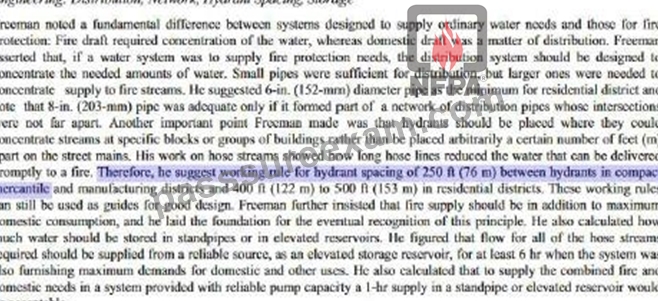
NEW QUESTION # 58
Which of the following approaches can be used to manage smoke in large that consists of allowing smoke to till the large volume space while occupants evacuate the atrium?
- A. Unsteady clear height
- B. Smoke filling
- C. Forced filling
- D. Steady clear height
Answer: D
NEW QUESTION # 59
Temporary storage of more than 60 gal (227 L) of Class I and Class II liquids should be low for from buildings under construction?
- A. At least 60 ft (18 m)
- B. At least 50 ft (15 m)
- C. At least 40 ft (12 m)
- D. At least 30 ft (9 m)
Answer: B
Explanation:
16.2.3.1 Storage:
* Storage of flammable and combustible liquids shall be in accordance with Chapter 66, unless otherwise modified by
16.2.3.
* Storage of Class I and Class II liquids shall not exceed 60 gal (227 L) within 50 ft (15m) of the structure.
* Storage area shall be kept free of weeds, debris, and combustible materials not necessary to the storage.
* Open flames and smoking shall not be permitted in flammable and combustible liquids storage areas.
* Such storages areas shall be appropriate posted as §no smoking ¨ areas.
* Storage areas shall be appropriately posted with markings in accordance with NFPS 704, Standard System for the identification of Hazards of Materials for Emergency Response.
NEW QUESTION # 60
Which of the following was the greatest means of awareness of a fire incident by people in the United States?
- A. Flt heat
- B. Saw fire
- C. Saw smoke
- D. Smelled smoke
Answer: C
Explanation:
Participant Population Awareness of the Fire.
The stimulus which first indicated to the participant the occurrence of the fire incident is recorded in Table XXXIV) It should be noted there were thirteen varied stimuli which tended to alert the participants as the fire incident. The most prevalent means of awareness of the fire incident, was the odor of the smoke produced by the fire incident. However, it should be noted the second most frequent means of awareness was the act of being notified by other participants of the fire incident. However, when this item of notification by others is combined with the fourth most frequent stimulus of being notified by a family member, the procedure of being notified by another person become the most prevalent means of becoming aware of the fire incident for 224 members of the participant population which was approximately 39 percent of this population. It should be noted under the third most frequent stimulus of noise, that 42 individuals were alerted by the noise of fire alarm signals or bells within the building, and the noise of other occupants moving in hallways or stairways was also mentioned frequently.
Relative to Table XXXIV, it appears the alerting actions of other individuals upon the discovery of a fire incident may be a very important mechanism. The physical variable related to the occurrence of a fire incident consisting of the odor of the smoke. The sing of the smoke or the flame, and the sensing of the heat, accounted for the initial awareness.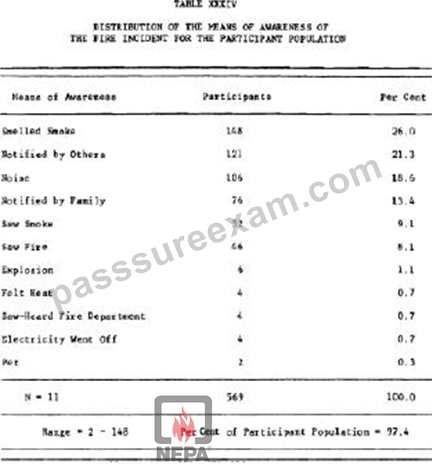
NEW QUESTION # 61
Combustibles should be moved away from cutting and welding operations a minimum distance of ________.
- A. 40 ft (12.2 m)
- B. 45 ft (13.7 m)
- C. 35 ft (10.6 m)
- D. 30 ft (9.1 m)
Answer: C
Explanation:
1910.252(a)(2)(iii)(A)(1)
Appreciable combustible material, in building construction or contents, closer than 35 feet (10.7 m) to the point of operation.
1910.252(a)(2)(iii)(A)(2)
Appreciable combustibles are more than 35 feet (10.7 m) away but are easily ignited by sparks.
1910.252(a)(2)(iii)(A)(3)
Wall or floor openings within a 35-foot (10.7 m) radius expose combustible material in adjacent areas including concealed spaces in walls or floors.
NEW QUESTION # 62
How many anthrax spores are needed to cause an anthrax infection?
- A. 100 to 1000
- B. 8000 to 10,000
- C. 1 to 10
- D. 2000 to 4000
Answer: B
NEW QUESTION # 63
A building with sleeping rooms rented to 16 or fewer people on either a transient or permanent basis, with or without meals, but without separate cooking facilities for individual occupants is what type of occupancy?
- A. Hotel
- B. Apartment
- C. Dormitory
- D. Lodging and rooming
Answer: A
Explanation:
Lodging or Rooming House. A building or portion thereof that does not qualify as a one- or two-family dwelling, that provides sleeping accommodations for a total of 16 or fewer people on a transient or permanent basis, without personal care services, with or without meals, but without separate cooking facilities for individual occupants.
NEW QUESTION # 64
To be considered a family day-care home, what is the maximum allowable number of clients?
- A. Two
- B. Six
- C. Twelve
- D. Four
Answer: B
Explanation:
The maximum allowable number of clients for a family day-care home varies by state and territory, but generally ranges from four to six children unrelated to the operator. A family day-care home is a facility in which a small group of children receive child care services in the provider's own home, such as a house, apartment, or condo unit1. To ensure a safe care environment, states and territories use child care licensing regulations to limit the number of children, as well as the number of infants and toddlers, that can receive care in a family day-care home1. Some states and territories may also offer certification or registration to help ensure some basic health and safety standards in certain home-based child care programs1. To learn more about how your state or territory regulates family day-care homes, you can visit the child care consumer education website and child care resource and referral agency for your state or territory1. Reference:
Family Child Care Homes | Childcare.gov
NEW QUESTION # 65
The three basic calculation methods used to determine rate of fire flow are the Royer/Nelson. US National Fire Academy, and_________.
- A. Hazen Williams
- B. Bernoulli calculation
- C. Sprinkler calculations
- D. Venturi principle
Answer: A
NEW QUESTION # 66
The Safety Class for propane refrigerant R-290 is
- A. B2
- B. B1.
- C. A3
- D. A2
Answer: C
Explanation:
Explanation
The safety class for propane refrigerant R-290 is A3, which means it has no toxicity but high flammability.
The safety class is determined by the ASHRAE Standard 34, which assigns a capital letter (A or B) for the toxicity level and a number (1, 2, or 3) for the flammability level of a refrigerant. Propane has a very low global warming potential and ozone depletion potential, but it also has a very low flash point and high auto ignition temperature, which make it highly flammable in the presence of ignition sources.References:Propane R-290 | Copeland US;R-290 Propane Refrigerant Fact & Info Sheet;Safety Data Sheet - Refrigerants; NFPA Fire Protection Handbook, 21st Edition, Chapter 3, Section 3.3.4.
NEW QUESTION # 67
When evaluating the hydraulic properties of water for fire protection system, what is the measurement of a fluid's resistance to flow?
- A. Velocity
- B. Pressure
- C. Viscosity
- D. Density
Answer: C
Explanation:
Explanation
The measurement of a fluid's resistance to flow is calledviscosity.Viscosity is the property of a fluid that describes how easily it can deform or move when subjected to a shear stress, such as the force exerted by a pipe wall or a pump1. A fluid with high viscosity, such as honey, resists flow and requires more pressure to overcome the friction between its layers.A fluid with low viscosity, such as water, flows easily and has less frictional resistance2.Viscosity affects the hydraulic properties of water for fire protection systems, such as the flow rate, pressure loss, and pump power3. Viscosity is usually expressed in units of pascal-second (Pa s) or centipoise (cP) for liquids, and is dependent on the temperature and composition of the fluid.References:
Viscosity | Definition, Facts, Formula, Units, & Examples
Viscosity - The Physics Hypertextbook
Fire Pump Types | NFPA
[12.4: Viscosity and Laminar Flow; Poiseuille's Law]
NEW QUESTION # 68
OSHA requires fire fighter training in hazardous materials, respiratory protection, and
- A. live fire training.
- B. communicable diseases.
- C. emergency communications.
- D. emergency medical services.
Answer: B
Explanation:
Explanation
OSHA requires fire fighter training in hazardous materials, respiratory protection, and communicable diseases.
According to OSHA standards, fire fighters must receive annual training in hazardous materials and infectious diseases, and initial and periodic training in respiratory protection. These topics are essential for fire fighters to protect themselves and others from exposure to harmful substances and pathogens.
References:OSHA training requirements for volunteer fire company personnel;What are the Current OSHA/PESH Training Requirement for Firefighters: A Review;Training requirements for firefighters;Training Requirements in OSHA Standards
NEW QUESTION # 69
Which dry agent is considered twice as effective as ordinary sodium bicarbonate-based dry chemical?
- A. Lithium chloride
- B. Potassium sulfide
- C. Potassium bicarbonate
- D. Monoammonium phosphate
Answer: D
NEW QUESTION # 70
......
New (2026) NFPA CFPS Exam Dumps: https://actualtests.passsureexam.com/CFPS-pass4sure-exam-dumps.html